When you search for something on Google today, the experience is very different from what it used to be.
You type a question, and instead of scrolling through a list of blue links, you often see a clear answer at the top of the page. Sometimes it explains the topic in a short paragraph. Other times, it summarises key points or answers in direct steps. In many cases, there is no need to click on any result. That’s the answer we are trying to rank for. It’s possible with the help of Answer Engine Optimisation (AEO).
The same behaviour is becoming common with AI tools like ChatGPT. People ask questions and get complete responses instantly. No searching. No comparing articles. Just an answer.
This change has a major impact on how brands show up online.
Ranking on page one still matters, but it is no longer enough. If your content cannot be clearly understood and reused as an answer, it risks being skipped entirely. That shift is exactly why conversations around What is AEO and AEO in SEO are becoming more important for businesses that rely on organic visibility.
Answer Engine Optimisation exists because search has moved from browsing to answering.
What is AEO?
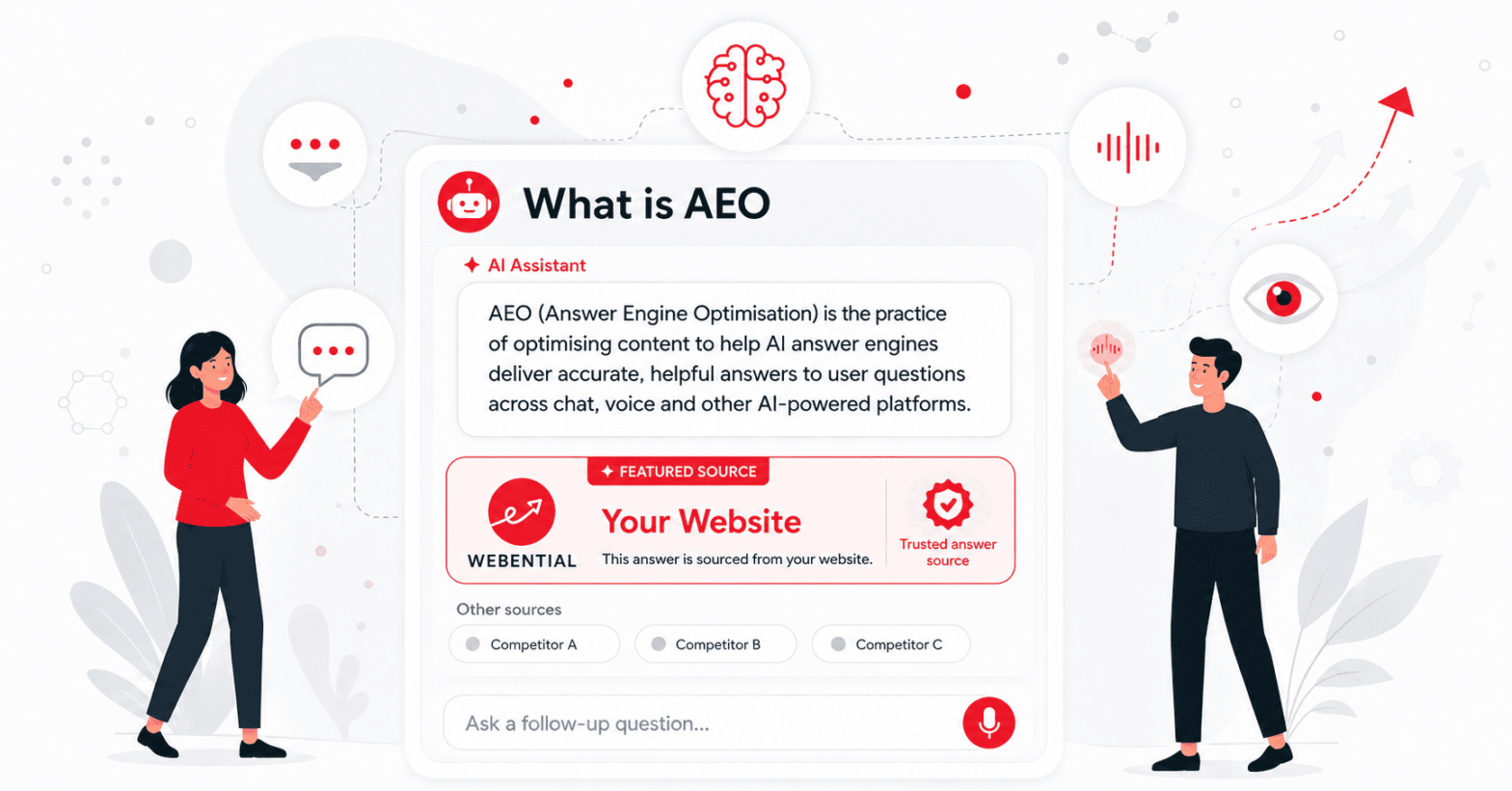
Answer Engine Optimisation is the process of optimising content so search engines and AI platforms can directly answer user questions using that content.
Instead of focusing only on rankings or clicks, AEO focuses on clarity and explanation. It helps platforms like Google AI Overviews, ChatGPT, Bing Copilot, and voice assistants understand what your content is saying and use it as part of their response.
A large share of user searches now end without a click because the question is already answered on the screen. In those cases, only content that is easy to understand and well-structured gets selected.
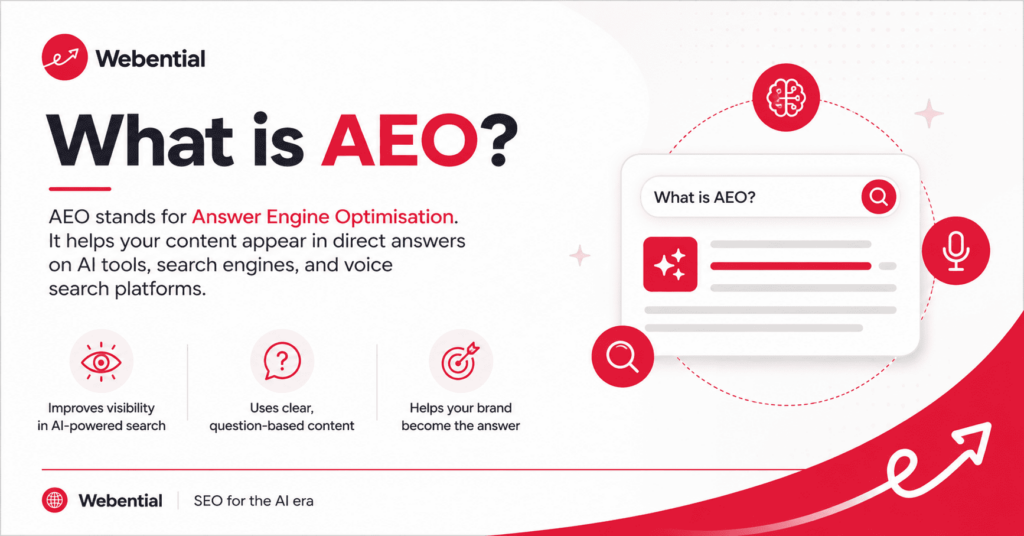
In simple terms, AEO helps your content become the answer, not just another result.
- SEO helps your page get found.
- AEO helps your content get used.
Why Search Is Becoming Answer-Based?
Search platforms are designed to reduce effort for users.
Most people are not looking to explore multiple viewpoints. They want clarity quickly. Answer engines work by collecting information from trusted sources and presenting a clear explanation in one place.
This is why content that is confusing, overly long, or poorly structured often fails to appear in AI-generated answers. These systems prioritise content that explains a topic cleanly and confidently.
Answer Engine Optimisation aligns your content with this reality.
Why Answer Engine Optimisation Matters?
Answer Engine Optimisation matters because visibility no longer depends only on clicks.
When your content is referenced or summarised by an answer engine, it builds trust and authority even if the user never visits your site. Over time, this influences brand recall and buying decisions.
For businesses offering services, this is especially important. Being seen as a reliable source at the moment someone is looking for clarity creates long-term value that traditional rankings alone cannot provide.
AEO also helps future-proof content as AI-driven search experiences continue to grow.
How AEO Works in SEO?
AEO works by improving how meaning is communicated.
Search and answer platforms evaluate content based on:
- How clearly a question is answered
- How early is the main point explained
- How focused the content is on the topic
- How logically do ideas flow from one section to the next
This is where AEO in SEO becomes critical. Traditional SEO ensures your content is discoverable. AEO ensures that discovery turns into understanding.
At Webential, we ensure our SEO services are also focused on AI-SEO. But, are they any different? Let’s find out more about the difference between AEO and SEO.
AEO vs SEO Explained in Simple Terms
The discussion around AEO vs SEO often gets reduced to short definitions, but the difference is more practical than theoretical.
SEO focuses on helping pages appear in search results. It relies on keywords, technical structure, and authority signals to improve rankings.
AEO focuses on helping content explain a topic well enough to be used as a direct answer. It relies on clarity, context, and structure.
Here is a clearer comparison in a table.
| Aspect | SEO | AEO |
| Primary goal | Improve rankings | Provide direct answers |
| Focus area | Keywords and optimisation | Explanation and clarity |
| User behavior | Click and explore | Read or listen instantly |
| Platform type | Search result pages | AI overviews and chat tools |
| Success measure | Traffic | Visibility and authority |
To sum up AEO vs SEO in short:
- SEO answers the question: Can this page be found?
- AEO answers the question: Can this content explain the topic clearly enough to be trusted?
Both are required in modern search.
How Answer Engine Optimisation Works in Practice?
AEO is not about writing less content. It is about writing clearer content.
In practice, this includes:
- Using clear question-based headings
- Answering the question early in each section
- Keeping explanations focused and specific
- Avoiding unnecessary filler
- Supporting answers with context instead of repetition
Answer engines favour content that sounds confident and complete. Pages that wander or bury key points often fail to get selected.
AEO and User Intent
User intent sits at the centre of Answer Engine Optimisation.
Most answer engines prioritise informational intent. These are searches that start with what, how, why, when, or which.
Optimising for AEO means understanding what the user wants to learn and structuring content around that learning journey.
A good AEO adapts explanations to intent without making content overly complex.
AEO and Inclusive SEO
Answer Engine Optimisation also supports inclusive SEO practices.
Clear structure, logical headings, and straightforward explanations make content easier to consume for a wider range of users, including those using assistive technologies.
Why AEO Matters for the Future of Search
Search is shifting toward explanation instead of exploration.
As more users rely on answer engines to guide decisions, brands that focus only on rankings will lose relevance. Brands that focus on clarity, intent, and explanation will continue to earn visibility and trust.
Answer Engine Optimisation is not a trend. It reflects how people already search.
If your goal is to stay visible where decisions are made, AEO needs to be part of your SEO strategy now.
And if you are ready to move beyond rankings and start owning answers, Webential is built to help you do exactly that.
How Webential Approaches AEO?
At Webential, AEO is not treated as a separate tactic.
We integrate Answer Engine Optimisation into our SEO workflows by:
- Structuring content around real user questions
- Improving topical clarity across pages
- Aligning content with AI-driven search environments
- Maintaining strong technical SEO foundations
This approach is part of our core SEO services and extends further through our AI SEO Services for brands preparing for answer-based search.
At Webential, we help brands stay visible where answers are chosen, not just where pages rank. Our AEO-led SEO approach is built to improve clarity, authority, and visibility across Google AI Overviews and AI answer platforms.If you want to understand how prepared your website is for answer-based search, you can get a free SEO audit from Webential. It shows exactly where your content stands and what needs to change to compete in modern search.
FAQs About AEO
What is AEO in SEO?
AEO in SEO refers to optimising content so it can be used by answer engines to directly respond to user questions while still supporting traditional search visibility.
Is Answer Engine Optimisation only for Google?
No. AEO applies to Google AI Overviews, ChatGPT, Bing Copilot, and other platforms that generate answers instead of listing links.
Does Webential provide AEO-focused services?
Yes. Webential integrates Answer Engine Optimisation into its SEO and AI SEO Services to help brands stay visible across modern search platforms.
Is AEO better than SEO?
This is not an AEO vs SEO choice. SEO and AEO work together. One helps content get found. The other helps content get trusted and referenced.